- News
Akriba at Beit Ben Yehuda ⚽
What Brings You to Jerusalem?
Filliene: Our visit to Jerusalem is part of an educational study trip focused on meeting young people and exploring football, fan culture and society in Israel. Our programme is funded through the PFIFF funding programme of the DFL and the Werder Bremen Foundation.
What is Akriba, and what does your work look like?
Filliene: Akriba is an educational project critical of antisemitism run by the LidiceHaus Youth Education Centre in Bremen. We offer workshops and training programmes for young people, young adults and multipliers who work in education.
Through our work, we aim to give young people accessible ways to engage with antisemitism by addressing topics relevant to their everyday lives. We support them in developing their own perspectives and strengthening their ability to respond to antisemitism.
How has 7 October affected your work?
The events of 7 October have also had an impact on educational work in Germany, and despite the considerable geographical distance, this impact is clearly felt. Spaces for dialogue have been lost in many areas, discussions around certain topics have become highly emotional, and the perspectives of those directly affected are not being heard. The rapidly increasing number of antisemitic incidents speaks for itself. This is precisely why it is so important to reopen these spaces, even on a small scale, and to establish direct contact with people on the ground.
How do you feel in Israel? What are your first impressions?
It feels surreal to actually be in a country that is so widely debated. The discourse is no longer taking place on social media or in the messages plastered on every streetlight with stickers. Instead, it is unfolding between us and the people we meet. I keep finding myself surprised. My previous knowledge of Israel now feels more like a lack of understanding, as my assumptions are repeatedly challenged. I have been to Israel before, mainly to Tel Aviv and the area around Ashkelon. But understanding what life here is really like is a complex matter. Life here continues despite the war. This means that I feel safe here, while the suffering of the people is something I mainly encounter through my own reflections and conversations.
Are there things about Israel that impress you or that have changed since your last visit?
This time, I was even more struck by how divided everything is. Jerusalem is a mosaic of different communities, which is particularly evident in the Old City, divided into four quarters that nevertheless function alongside one another. The importance of religion in the lives of some people is unmistakable, and religious communities come together in this holy city. This impresses me, and spending time here has made me even more aware of it, especially compared with my trip in 2019. At the same time, it makes me sad that the people in this country have to experience so many tragedies and that there seems to be no solution for them. Since 7 October, this sense of sorrow and concern has become a new feeling for me. During the trip, I realised that Israel, as the world’s only Jewish state, cannot be understood in just one week. Nevertheless, this experience has given me an insight that I would not want to have missed.
Why is it important to you to make this trip? And what can you tell us about the main themes?
Nils: It was important to me to make this trip so that I could form my own impression of the political situation in Israel and learn more about the people living here and their perspectives, even though any insight gained in such a short time must necessarily remain fragmentary. This was particularly important against the backdrop of the highly charged political discourse about Israel in Germany, which is also strongly shaped by Germany’s role as the country of the perpetrators of the Holocaust. For this reason, I found our focus on the politics of Holocaust remembrance in Israel, as well as the apparent differences between German and Israeli cultures of remembrance, particularly interesting. Our second focus was on exploring football and fan culture in Israel. It became clear that football is much more politically charged here than in Germany. This gave us a more specific perspective on political conflicts in Israel, one that does not play a major role in the broader political discourse.
What did you do and experience during the week?
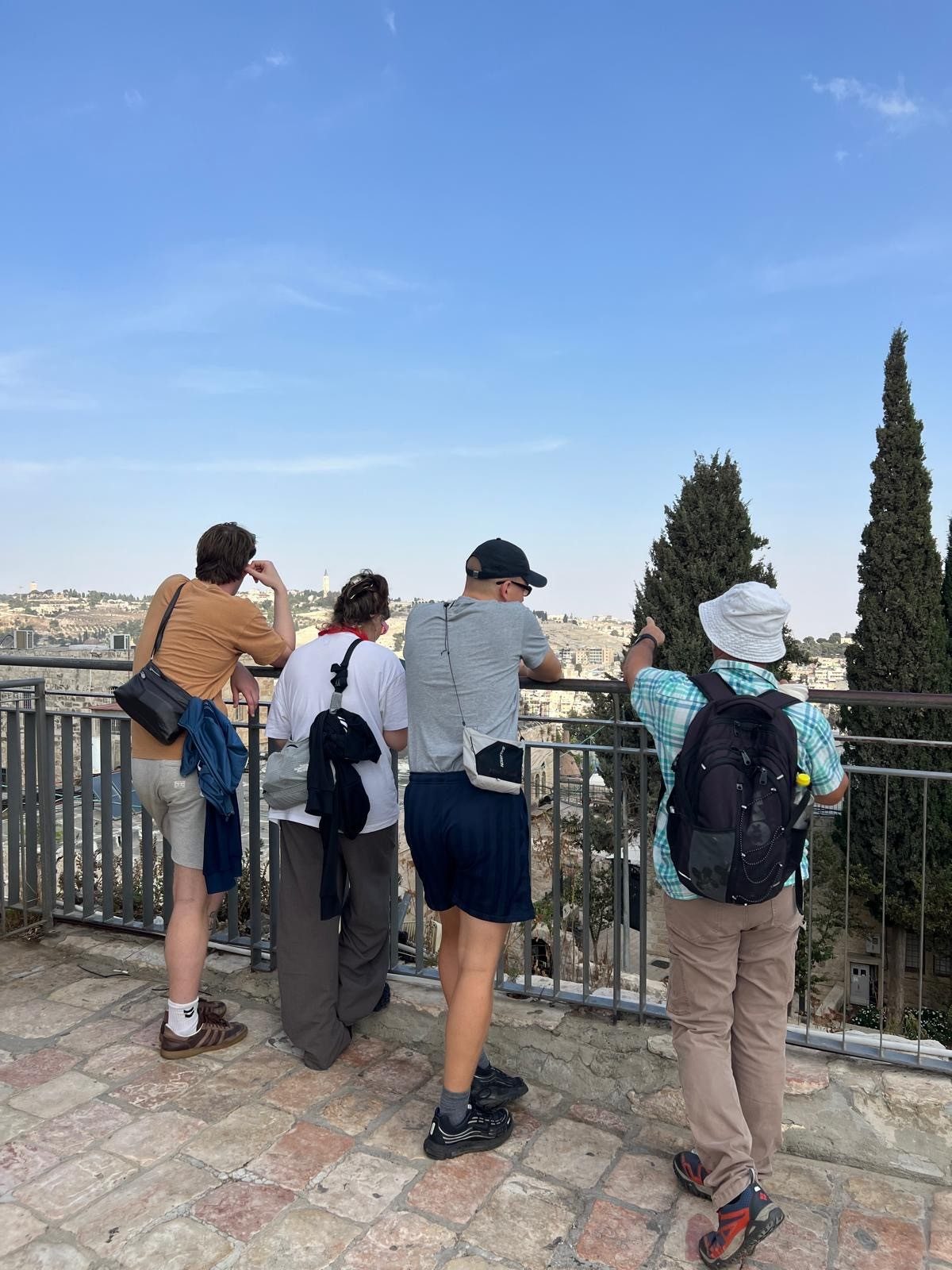
Moritz: We began the week with a tour of Jerusalem’s Old City, which gave us a first, albeit superficial, impression of the diversity of Israeli society. On the second day, we visited Yad Vashem and then explored the Mahane Yehuda Market. The following day, we visited Beit Terezin in Givat Haim and explored the relationship between football, culture and life in the Theresienstadt Ghetto. The first few days of our trip were therefore dedicated to engaging with the Shoah and exchanging views with various people about Israeli society and its development. We encountered many different perspectives that were previously unfamiliar to us and opened up new ways of looking at things. On Friday, the focus shifted somewhat. During a visit to Teddy Stadium, we learned about the work of Hapoel Jerusalem and the social responsibility that is central to the club’s identity. On Shabbat, we took time to reflect on our impressions so far and to slow down. On Sunday, we travelled to an away match of Hapoel Jerusalem, where we gained insight into football and fan culture in Israel.
What will you take away from this trip? Which impressions were particularly formative, and which might also be relevant to your future work in Germany?
Moritz: One of the key things we take away is that there are many different perspectives on the situation since 7 October. There is simply no single “Israeli perspective” — and that is a good thing. We also realised that even after a week, we are only at the beginning of understanding this society, and there is still so much we do not know. We also gained a new perspective on how the Shoah is approached and remembered. This perspective was unfamiliar to us, but valuable, and differed from the European perspective we were used to. Encountering the different perspectives of various groups and individuals makes this experience particularly relevant to our work in Germany. We came to realise how much we still do not understand, and that understanding is an ongoing process that never truly comes to an end. The many questions that remain open encourage us to keep learning, reflecting and engaging with these issues.